
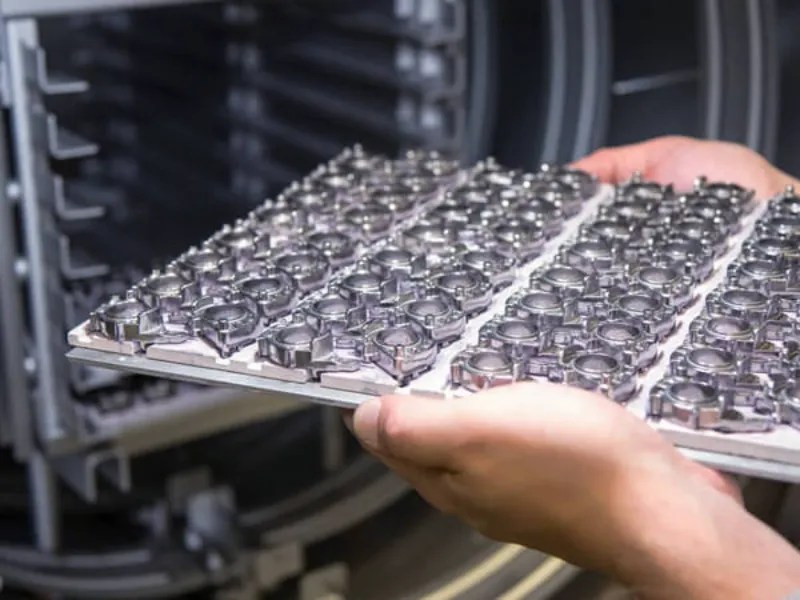
What a MIM Manufacturer Does
A MIM manufacturer produces metal components through the metal injection moulding process, a technique that combines powdered metallurgy with plastic injection moulding to create net-shape metal parts with complex geometries and tight dimensional tolerances. The process is not simply pressing metal into a shape; it involves formulating a precise feedstock, engineering a mould that accounts for predictable shrinkage, controlling a debinding process that removes the binder without damaging the part, and sintering the component under carefully managed temperature profiles. Each of these stages requires specialist knowledge and consistent execution to produce parts that meet industrial and medical specifications.
The Process That Defines MIM Manufacturing
MIM manufacturer operations begin with feedstock: fine metal powder blended with a thermoplastic binder to create a material with the flow characteristics of plastic but the composition of metal. The feedstock is injected under controlled pressure into a precision mould designed to produce the desired geometry after the dimensional changes of processing are accounted for. Debinding removes the binder through thermal or solvent methods, leaving a porous structure of metal particles held loosely in the part shape. Sintering at high temperature fuses those particles into a dense, strong component.
The dimensional accuracy achievable through this process typically falls within plus or minus 0.3 percent of nominal values, which satisfies the requirements of most medical, aerospace, and precision industrial applications.
The Parts Best Suited to MIM
Metal injection moulding for precision parts delivers its greatest advantage on components that are small, geometrically complex, and produced in volumes that justify tooling investment. Parts weighing between 0.1 and 100 grams, with wall thicknesses between 0.5 and 6mm, and with features such as internal threads, undercuts, and cross-holes are well-matched to the capabilities of MIM. Parts larger than this, or parts with very simple geometries at low volumes, are often better served by machining or casting.
Surgical instrument tips, endoscopic links, firearm trigger components, and electronic connector housings are among the component families produced through MIM across multiple industries worldwide.
Material Selection in MIM Manufacturing
“Excellence in manufacturing begins with choosing the right material for the right application,” a principle that Singapore’s precision manufacturing sector has applied consistently in building its global reputation. Precision MIM production accommodates a range of alloys selected by the manufacturer based on the mechanical properties, corrosion resistance, and biocompatibility requirements of the application. Stainless steels, particularly 17-4 PH and 316L, are the most commonly processed. Low-alloy steels provide high tensile strength for mechanically demanding components. Titanium alloys serve weight-sensitive aerospace and implantable medical applications. Cobalt-chromium is specified for long-term implants requiring sustained biological compatibility.
The choice of alloy affects the sintering temperature, the shrinkage rate, and the final mechanical properties, making material selection an engineering decision that requires process knowledge alongside design intent.
Tooling Quality and Its Effect on Part Accuracy
The mould is the most consequential piece of equipment in MIM manufacturer operations. A mould engineered with insufficient shrinkage compensation will produce parts that fall outside tolerance after sintering, regardless of how well the subsequent stages are controlled. A mould with poor gating design will produce inconsistent fill, leading to density variations and dimensional instability. Mould maintenance – cleaning, polishing, and periodic re-qualification – determines how long a tool remains capable of producing parts within specification.
The investment in tooling at the outset of a MIM project is repaid across the production run in consistent part quality and reduced scrap.
Quality Management in MIM Operations
Metal injection moulding manufacturers operating for medical and aerospace customers maintain quality management systems certified to ISO 13485 or AS 9100, respectively. These systems require documented process controls at each stage of production, material traceability from incoming powder through final inspection, internal audit programmes, and corrective action systems that address out-of-specification results systematically. For medical device customers in particular, the quality management system forms part of the regulatory submission that the OEM assembles for device market authorisation.
A MIM manufacturer whose quality system documentation is current, whose certifications are maintained through regular third-party audits, and whose production data demonstrates sustained process capability provides a lower-risk supply option than one whose compliance documentation cannot be readily produced.
Choosing the Right MIM Manufacturing Partner
Evaluating a MIM manufacturer requires assessing process capability through first article inspection data, reviewing quality certification status, examining the range of alloys and geometries successfully produced, and understanding the supplier’s approach to tooling development and design support. Suppliers that engage with design engineering questions – offering advice on geometry, tolerance, and material selection – add value that goes beyond simply producing parts to a drawing.
A capable MIM manufacturer brings process knowledge to the design stage and production discipline to the manufacturing stage, delivering complex metal parts with the consistency that demanding applications require.

 247 Web Technology Blog